01 — Foundation
Software engineering
iOS applications, architecture, networking, real‑time communication and secure application development.
Sadman Sakib Saumik
From software to robotics.
I started as an iOS engineer, building a foundation in application architecture, networking, real‑time communication protocols and security. Alongside that career, a robotics practice that began with Mars rovers grew into autonomous systems, drones and connected devices. Today I lead engineering across AI, robotics and IoT — where software, intelligence and machines meet.
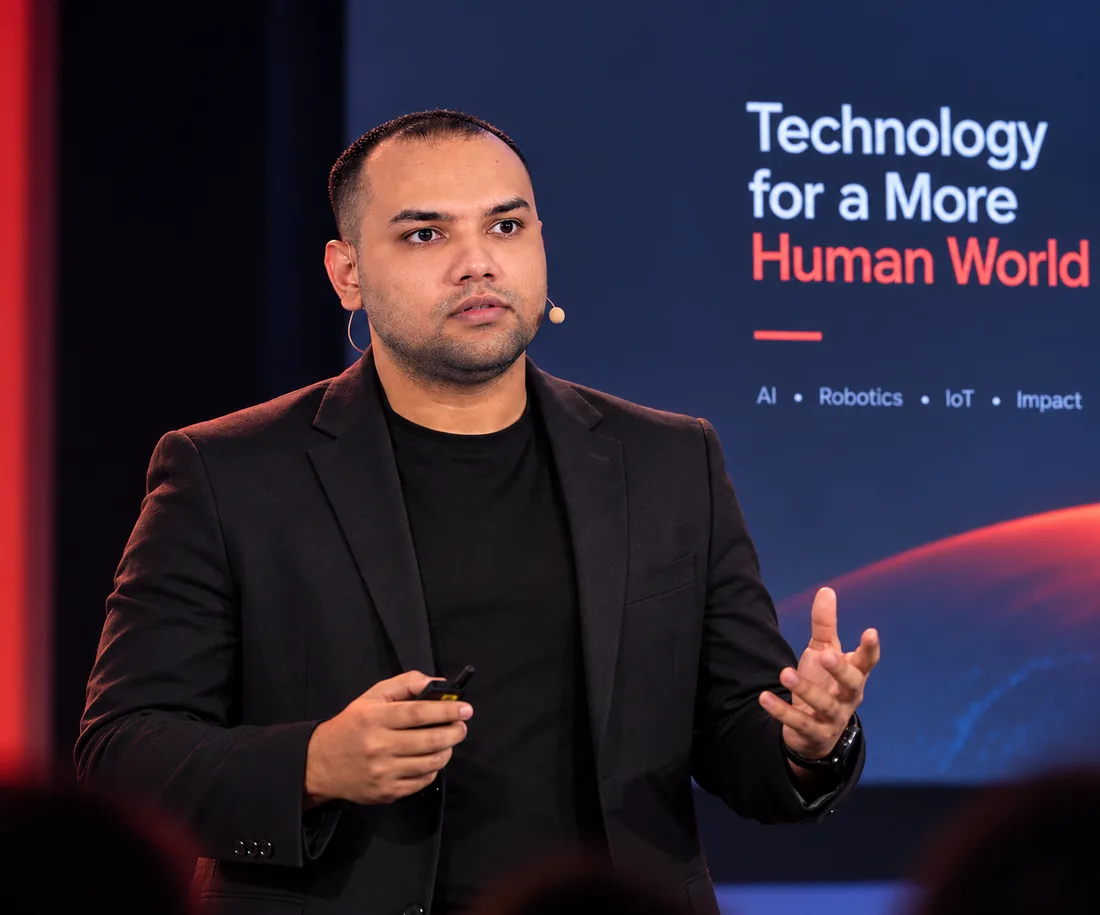
Engineering Lead — AI, Robotics & IoT
Assistant Principal Software Engineer
Brotecs Technologies
saumik.net
01 — Foundation
iOS applications, architecture, networking, real‑time communication and secure application development.
02 — Parallel track
Mars rover development, international rover competitions, autonomous systems and drone technologies.
03 — Today
Engineering lead for AI, robotics and IoT — AI‑assisted engineering, computer vision, connected devices, security and solution architecture.
Software
Protocol engineering at the layer most application developers never open. SIP for signalling, SDP for description, RTP for media — and IAX2, which carries signalling and media together over one port. Two architectures for the same problem.
SIP · SDP · RTP · IAX2
Robotics
2018
First professional role
iOS
Starting platform
Core technologies
Language
Swift
UI
UIKit
UI
SwiftUI
Language
Objective‑C
Transport
Networking
Real‑time
VoIP
Signalling
SIP
Description
SDP
Media
RTP
Signalling + media
IAX2
Device I/O
Serial
Automation
SSH · Telnet
Connected devices
IoT
Discipline
Protocol Engineering
Hardening
Application Security
Session Description Protocol, carried inside SIP. It describes what each side can do — codecs, ports, media direction — so both ends agree before a single packet of audio moves.
Application
What the user sees
Security layer
Pinning · Integrity · Certificates
Communication
Secure channels in transit
Infrastructure
Devices, services and where it lands
Practices
SSL Pinning
Root & Jailbreak Detection
Secure Certificate Handling
Secure Communications
Coverity
Black Duck
Static Analysis
Dependency Management
The through-line
Where it applies
Integration over invention: choosing the model that fits the constraint and wiring it into the system that needs it, at the latency the system can afford.
System anatomy
University
Designing, building and testing a rover for Mars‑analogue terrain — mechanical integration, control and vision in one system.
01 / 05
Utah · USA
Team member at the University Rover Challenge in Utah, USA — a field competition run on terrain chosen for its resemblance to Mars.
02 / 05
Poland
Led Team Mongol Barota to the European Rover Challenge in Poland — leadership under a deadline that does not move.
03 / 05
Autonomous systems
04 / 05
Drones & IoT
Where the rover work led: systems that move through three dimensions, decide their own path, and stay reachable over telemetry while they do it.
05 / 05
Flight Automation
Obstacle Avoidance
Autonomous Landing
Computer Vision
Telemetry & Control
Simulation
Practical understanding of drone flight fundamentals and basic aerodynamics alongside autonomous‑system development — enough to reason about the airframe, not a specialisation in aerospace engineering.
Reasoning
AI
Perception
Computer Vision
Measurement
Sensors
Connectivity
IoT
Embodiment
Robotics
Independence
Autonomy
Intelligent Systems
See · Decide · Act
Perception
Vision that reads a scene the way the task requires, not the way a benchmark rewards.
Decision
Autonomy that commits to an action and can account for the input that produced it.
Delivery
Systems that reach the field with the security and architecture to survive being there.
Native applications built for enterprise deployment — architecture, networking and secure distribution.
Enterprise iOS applications built from scratch and carried through six years of releases: interface, feature logic, networking and the scalable architecture underneath.
Workflow intelligence and task analysis applied to how engineering work actually gets done.
Platforms that read source code, analyse tasks and evaluate engineering performance — automated review insight wired into the workflows an organisation already runs on.
Detection and visual analysis pipelines, from dataset workflow through to production inference.
Computer‑vision and image‑analysis pipelines for intelligent automation: model integration, dataset handling and deployment into systems that already have users.
Devices, terminals and control systems brought under one programmable interface.
Script‑driven applications built from scratch to automate SSH, Telnet and serial‑based systems — collapsing manual terminal operations into repeatable process execution across connected hardware.
Flight automation with obstacle avoidance, autonomous landing and onboard perception.
Obstacle avoidance, autonomous landing and AI‑assisted detection, developed across simulation environments and proven in field deployment.
Real‑time communication over SIP, SDP, RTP and IAX2, hardened with pinning and certificate control.
SSL pinning, root and jailbreak detection, and an automatic app‑server certificate update mechanism that keeps applications available without loosening the standard that protects them.
Summary
Lead engineering across AI‑driven systems, iOS development, application security, IoT and autonomous technologies. Own system architecture, protocol customisation and secure application development, alongside technical reviews and cross‑functional delivery. Build AI‑assisted platforms for automated code review, task analysis, engineering performance evaluation and computer vision, integrated with the organisation’s own workflows.
Computer Science & Engineering
Military Institute of Science and Technology (MIST), Dhaka
Mars rover development, a rover team led to two international competitions, and the autonomous‑systems work that grew out of it.
Connects → Drones · IoT · Computer Vision · Research